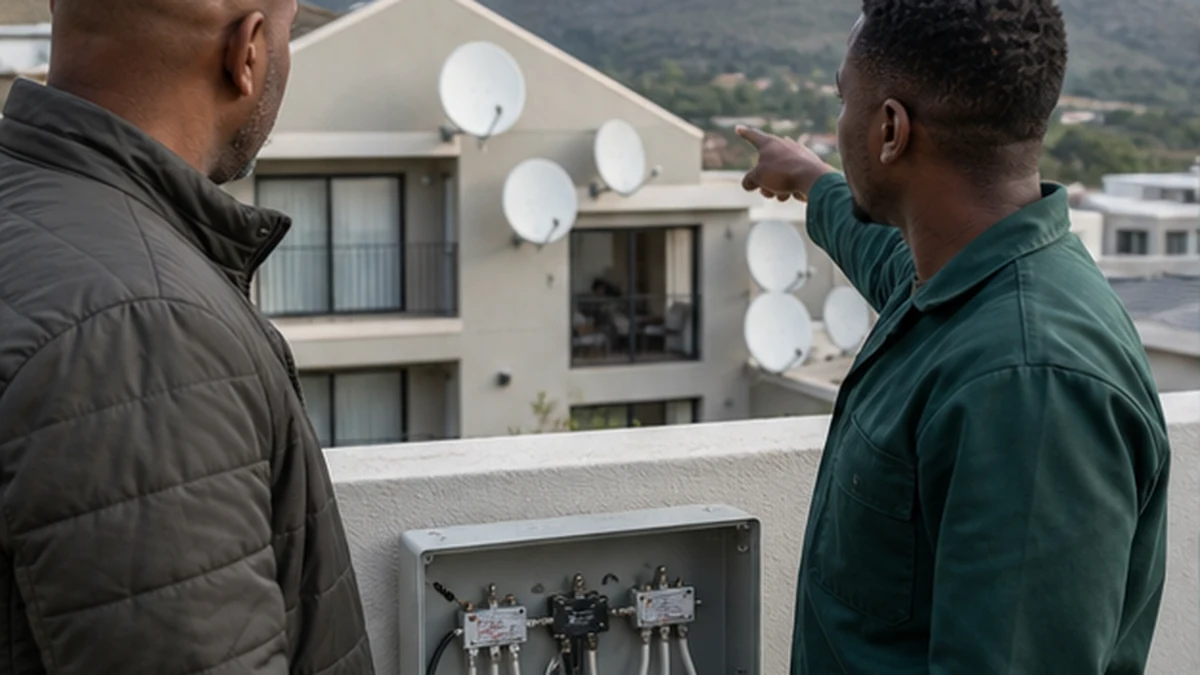
Communal DStv and individual dishes solve the same reception need in different ways. A communal system uses shared reception equipment and distributes signal to several homes or units. Individual installations give each household its own dish and direct cable path. For Noordhoek estates, the decision affects appearance, maintenance access, upgrade planning and who is responsible when a fault occurs. Signal design and governance should drive the decision. The visible dish count is secondary. A well-documented shared system can be efficient. A poorly planned one can make simple faults hard to isolate.
How communal DStv works in Noordhoek estates
A communal system normally places the dish and head-end equipment in an approved shared location. Distribution then carries the required satellite signals to each unit through suitable cabling and components. The design must account for cable distance, losses, decoder requirements and future capacity.
This is more than splitting one household cable. Shared infrastructure needs correct equipment, power arrangements, labelling and test points. The commercial and multi-screen installation service is the relevant starting point for a body corporate, homeowners association or managing agent planning a system for several occupancies.
- Approved dish and head-end position
- Documented distribution paths
- Accessible test and isolation points
- Capacity for intended decoder types
- Clear maintenance responsibility
Benefits and limits of individual dishes
An individual dish gives the household a direct signal path and clearer control over maintenance. A technician can test from that home to its own dish without tracing shared distribution. Upgrades may also be easier when the estate permits suitable mounting and line of sight.
The disadvantage is visual repetition and inconsistent workmanship. Several reflectors on façades can undermine estate appearance, while uncoordinated cable routes create waterproofing and maintenance risks. Wind-exposed walls may also be poor mounting positions. Approval rules should define acceptable locations and removal obligations.
Comparing appearance and maintenance in Noordhoek
Chapman’s Bay Estate, Lake Michelle, Noordhoek Manor and Silvermine Village may each approach external fittings differently. A communal dish can reduce visual clutter, but central equipment requires planned access. Individual dishes spread maintenance across owners but may be mounted where estate staff cannot monitor workmanship.
Ask who can authorise work, who holds system drawings and how residents report faults. A shared outage should not trigger random changes inside every home. The decoder and signal troubleshooting service can help distinguish a decoder issue from a distribution fault when technicians have access to useful test points.
Signal design and future upgrades for Noordhoek estates
The system must support the services residents actually use. Decoder generations and distribution requirements can change, so spare capacity and accessible routes are valuable. Long cable paths need appropriate design. Adding boosters without measurement can overload some points while leaving others weak.
Before altering a shared network, record levels at the head end and affected units. Label every outgoing line. If residents want independent viewing in several rooms, household Extra View requirements must be considered alongside what the communal network can deliver. The two systems cannot be planned separately.
- Current and expected decoder mix
- Number of units and active outlets
- Longest distribution routes
- Backup power needs for active equipment
- Space for safe future expansion
Choosing a practical estate policy
The policy should state whether residents must use the communal network, when a private dish can be approved and which contractors may work on shared equipment. It should also define fault boundaries. For example, the estate may maintain the head end and riser, while the owner maintains cabling inside the unit.
A site survey should inspect line of sight, equipment location, existing ducts and condition of legacy cable. Resident requirements then inform the technical brief. Use the Noordhoek systems contact page to arrange an assessment, and keep approved drawings and test records with the estate documents.
Procurement should compare lifecycle responsibilities as well as installation scope. A communal proposal needs a component schedule, distribution drawing, unit test results and a maintenance handover. An individual-dish policy needs approved fixing details, cable routes and a removal standard. In both cases, contractors should record changes so later technicians do not disconnect another resident while tracing an unlabelled feed. Residents also need a simple reporting path that identifies whether the problem affects one room, one unit or several homes. That first observation can direct the correct technician to the correct part of the network. Review the policy when major decoder or distribution changes arise. Planned review is safer than allowing individual alterations to accumulate until no one understands the shared layout.
Frequently asked questions
Is communal DStV better for every Noordhoek estate?
No. It is useful where appearance, density and shared access favour central reception. Smaller developments with easy, discreet mounting may prefer controlled individual dishes. The choice depends on design and management capacity.
Who repairs a communal signal fault?
Responsibility should be set in the estate policy. The managing body often controls shared equipment, while a resident may be responsible after the unit handover point. Clear test boundaries prevent disputes.
Can a resident install a private dish if communal signal is poor?
Only with the required estate or body corporate approval. The better first step is to measure the communal feed and repair the shared fault. An unauthorised dish can create appearance and access issues.
Can Extra View run from a communal system?
It may be possible when the shared distribution and decoder setup support the required signals. The network must be assessed rather than assuming that any wall outlet can support linked decoders.